
Circle of Willis: Arterial Anatomy, Collateral Perfusion & Aneurysms
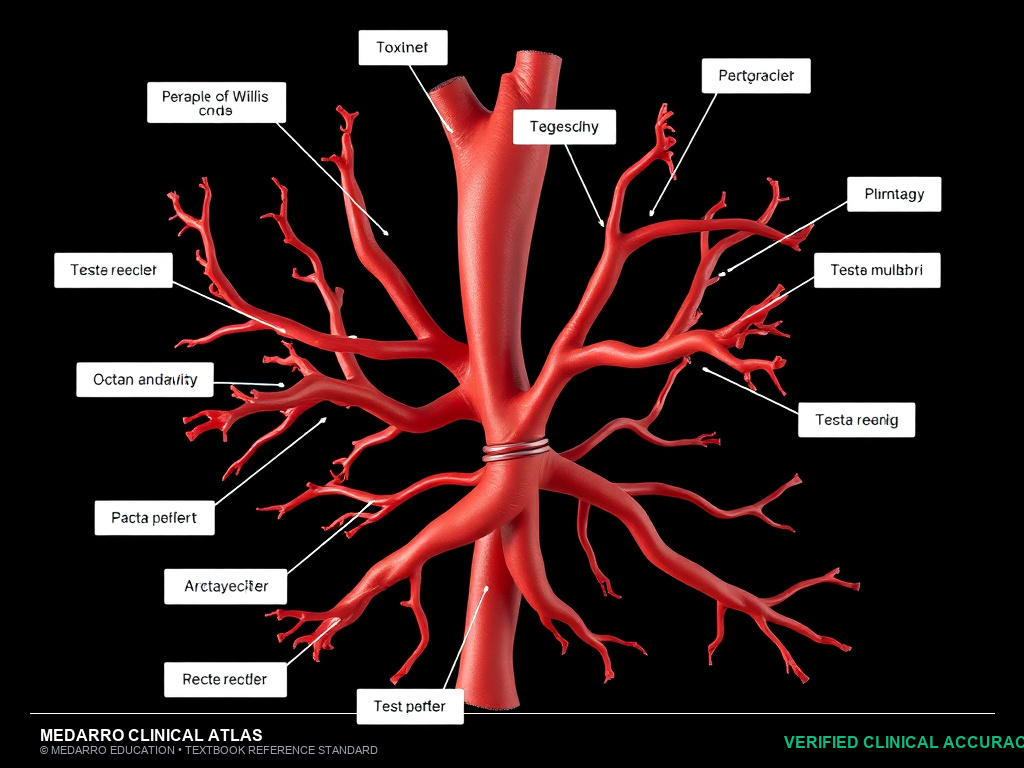
High-Yield Clinical Pearls & Exam Keys
Berry (saccular) aneurysms characteristically occur at arterial bifurcation junctions due to congenital defects in the tunica media and internal elastic lamina.
The junction of the Anterior Communicating Artery (ACom) and Anterior Cerebral Artery (ACA) is the most frequent aneurysm site (85-90% in anterior circulation).
Compression of the 3rd cranial nerve (oculomotor) by a Posterior Communicating Artery (PCom) aneurysm begins with pupillary dilation because parasympathetic pupil-constricting fibers run superficially.
Ask Dr. Medarro about Human Anatomy
Instant NMC-grounded answers with standard textbook citations
Ruptured PCom Aneurysm Triad
Sudden 'thunderclap' occipital headache (worst headache of life)
Ipsilateral pupil dilation & non-reactivity (compression of outer parasympathetic CN III fibers)
Down-and-out ocular deviation with severe ptosis
Collateral Perfusion Across Cerebral Arteries
| Arterial Segment | Normal Flow Role | Collateral Role in Stenosis |
|---|---|---|
| Anterior Communicating (ACom) | Minimal baseline cross-flow | Shunts blood from contralateral ICA to ischemic anterior hemisphere |
| Posterior Communicating (PCom) | Bridges anterior & posterior loops | Shunts blood from vertebrobasilar basilar artery to anterior circulation |
| Basilar Artery Bifurcation | Feeds bilateral posterior cerebrals (P1) | Primary inflow source for entire brainstem & occipital visual cortex |
Interactive Clinical Vignette Practice
Live Rule-Out EngineA 48-year-old woman presents with a sudden, agonizing 'thunderclap' headache with neck stiffness. Examination reveals right-sided pupillary dilation and complete ptosis with down-and-out deviation of the right eye. CT reveals subarachnoid hemorrhage. An aneurysm at which arterial junction is most likely responsible?
Unlock Complete Viva Traps & Additional Case Vignettes
Access model examiner answers, comprehensive rule-out breakdowns, and 4K spotter explanations.
Want 50+ Clinical Vignettes & 4K 3D Spotters on Human Anatomy?
Practice Spaced Repetition Decathlon, generate instant 7-day adaptive study plans, and upload your college PDFs into the personal vault.